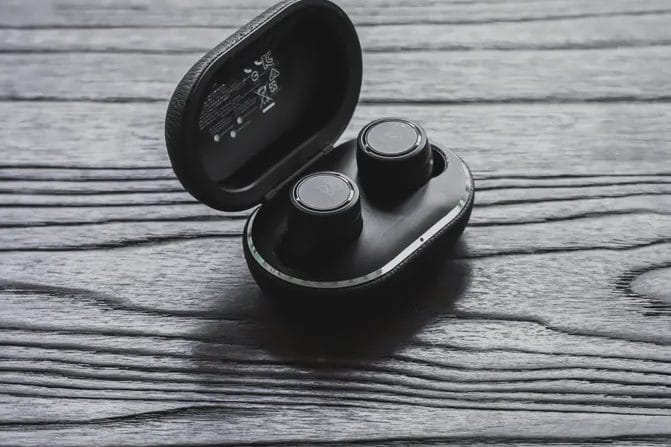
Somewhere between the third dead pair of cheap earbuds and the £280 flagship set that still fell out during a jog, most men figure out that the spec everyone argues about — noise cancellation depth, measured in decibels nobody can actually perceive in isolation — isn't what determines whether a pair survives daily use. It's the seal. An earbud that doesn't sit right leaks bass, lets in traffic noise no ANC chip can fully cancel, and falls out exactly when you reach for your Oyster card on a crowded platform.
Fit first, features second
Sony's WF-1000XM5 and Bose's QuietComfort Ultra Earbuds both ship with three or four silicone tip sizes, and swapping the default medium tip for a size up or down changes the experience more than any firmware update will. A loose seal drops effective noise isolation by roughly 8-10dB regardless of how good the active cancellation chip is underneath — the physical seal does most of the real-world blocking, and the electronics clean up what leaks through. Try all four tip sizes before deciding a pair "just doesn't work for your ears." Nine times out of ten it's the wrong tip, not the wrong earbud.
Apple's AirPods Pro 2 solved this differently with an in-app fit test that measures leakage using the earbud's own microphone, and it's genuinely useful even if you're not otherwise an Apple-ecosystem person — the fit test alone is worth running once on any silicone-tip earbud, Apple or not, just to hear what a proper seal sounds like against a bad one. Once you know what good isolation actually feels like, cheaper earbuds with the same tip sizing stop feeling like a downgrade.
What £150-£280 actually buys you in 2026
- Sony WF-1000XM5 (£259): the best all-round ANC and call quality in the category, six-hour battery life per charge, weakest transparency mode of the three flagships
- Bose QuietComfort Ultra Earbuds (£279): the deepest low-end ANC for engine noise and aircon hum, best-in-class transparency mode, shortest per-charge battery at 4.5 hours
- Apple AirPods Pro 2 (£229): the tightest integration if you're on an iPhone, adaptive audio that's genuinely useful on a mixed commute, mediocre standalone experience on Android
- Samsung Galaxy Buds 3 Pro (£219): closest Android equivalent to the AirPods experience, blade design fits some ear shapes better than round tips, six-hour battery
- Nothing Ear (£129): the value pick — 90% of the ANC performance of the flagships for half the price, weaker app and fewer firmware updates over time
We'd steer most men towards the Nothing Ear unless you specifically need the call-quality edge Sony has, or the transparency mode Bose has for cycling through traffic. Paying an extra £130 for a marginal ANC improvement most people can't reliably distinguish in a blind test isn't a good use of money — put the difference towards a proper case or a second charging cable instead.
Battery life is quietly the bigger problem
Every flagship pair advertises 24-30 hours of total playback "with the case," which is technically true and practically misleading. The earbuds themselves hold 4.5 to 6 hours before needing a top-up, and that number degrades meaningfully after 18-24 months of daily charge cycles — lithium-ion cells lose roughly 20% of their original capacity after around 500 full charge cycles, which for a daily commuter pair works out to somewhere around year two. A pair that gave you six solid hours on day one might only manage four and a half by its second birthday, and there's no fix for that beyond buying a new set or, on Sony and Bose models, paying for a battery replacement through their repair programme.
The case matters more than most buying guides admit. A case that charges via USB-C and supports wireless Qi charging (Sony, Bose and Apple all do in 2026) means you can top it up on the same pad as your phone overnight, which sounds trivial until you're the guy standing on the platform with 8% battery and a cable-only case at home. Nothing's case skips wireless charging on the base Ear model to hit its lower price point — worth knowing before you commit if you already run a nightstand charging pad.
Questions worth answering before you buy
- Do you actually need transparency mode, or do you mostly listen with ANC fully on? If it's the latter, Bose's transparency advantage is wasted money.
- Is your commute mostly Tube, bus, or car? Tube favours deep low-frequency ANC (Bose); car and open-plan office favour better call-quality mic arrays (Sony).
- iPhone or Android? The cross-platform penalty is real — AirPods Pro 2 lose spatial audio, adaptive transparency and half the app's features on Android.
- Will you actually use the app? If not, buy on hardware fit and battery alone, because the software differentiators (EQ presets, fit tests, firmware updates) only matter if you open the app more than once.
The case for skipping true wireless entirely
Not every commute needs true wireless earbuds, and it's worth saying plainly: if you're doing long-haul flights or full workdays with headphones on, over-ear ANC headphones still beat any earbud on battery life and bass depth, full stop — nobody's fixed the physics of a tiny 6mm driver competing with a 40mm one. Earbuds win on the 20-40 minute daily commute where pocketability matters more than absolute audio quality, and that's genuinely the use case they were designed for. Buying flagship earbuds for eight-hour work-from-home days and then wondering why your ears ache by 3pm is buying the wrong tool for the job.
If your actual pattern is short bursts throughout the day — gym, commute, a call while walking to lunch — the calculus flips back in earbuds' favour immediately, and that's most men's actual usage pattern whether they admit it in the buying guide comparison chart or not.
Whatever you land on, replace the stock tips within the first week if the default medium size doesn't disappear in your ear within about ten seconds of putting it in. That one five-minute adjustment fixes more "these earbuds are rubbish" complaints than any firmware update Sony or Bose will ship this year.