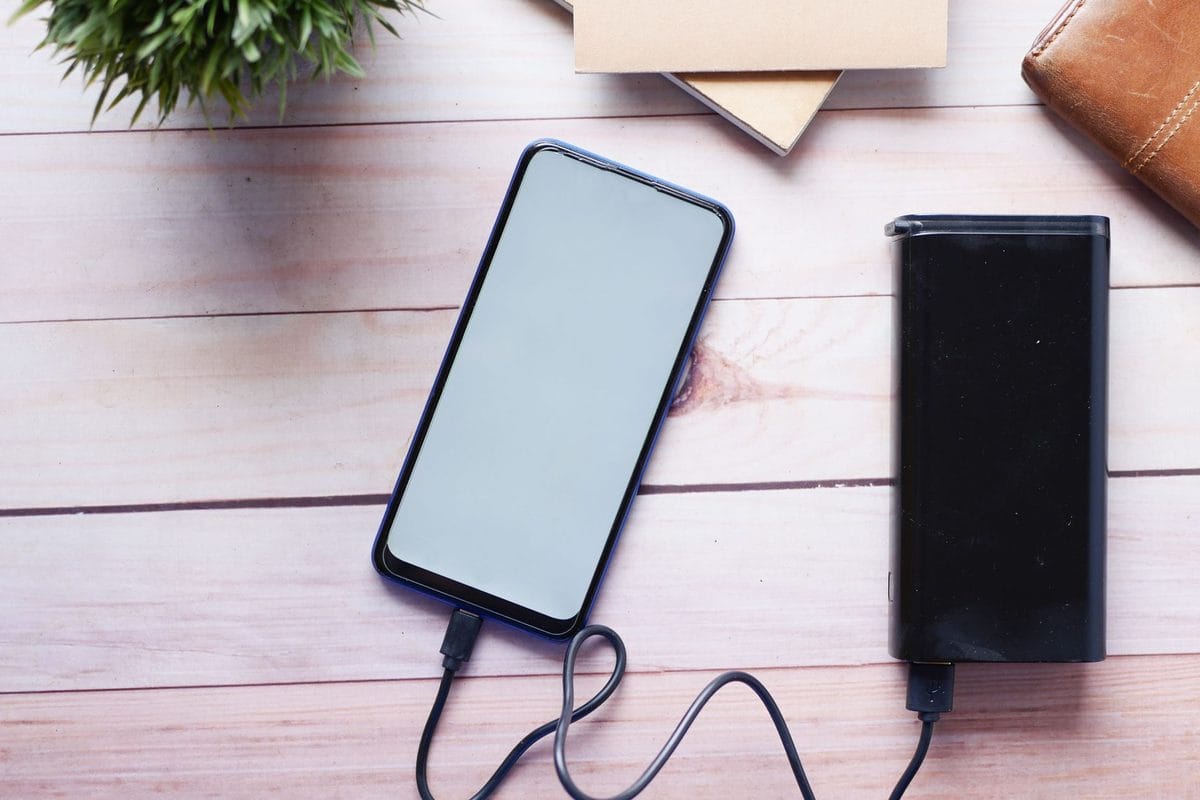
Why the mAh number on the box misleads you
You are at the gate with 6 percent on your phone and a flight that boards in forty minutes. The power bank in your bag says 20,000 mAh, which sounds like it should charge your phone several times over. Sometimes it does. Often it gives you one full charge and a little left over, because mAh measures charge at a voltage the box rarely mentions. Watt-hours (Wh) measure the energy itself, and that is the number worth comparing before you pay.
The conversion is simple. Multiply the milliamp-hours by the nominal cell voltage, usually 3.6 or 3.7 volts for lithium-ion cells, and divide by 1,000. A 20,000 mAh bank works out to roughly 72 to 74 Wh. A 10,000 mAh model is about half that. Most manufacturers print the Wh figure in small type on the back or in the spec sheet, so check there before you trust the headline capacity.
The 100 Wh line that decides what you can carry on
Airlines care about watt-hours, not milliamp-hours. Under the IATA guidance most carriers follow, lithium batteries up to 100 Wh can go in cabin baggage without approval. Between 100 Wh and 160 Wh you usually need the airline's permission, and anything above 160 Wh is not allowed on a passenger flight. Some carriers set stricter limits, and a few cap the number of power banks per passenger, so check your airline's own page before you fly.
This is why a 20,000 mAh bank is a quiet headache at security. Its 72 to 74 Wh sits comfortably under the 100 Wh line. A 26,800 mAh model, which is about 99 Wh at 3.7 volts, only just clears it. Anything marketed as 30,000 mAh or more will often land above 100 Wh, and that is the one that gets pulled out of the tray at the gate.
How much of the charge you actually get
Stored energy and delivered energy are not the same number. Every conversion step loses some of it as heat. The cell has internal resistance, the boost circuit raises the voltage for USB-C, and the controller manages the charge going in and out. In practice, expect roughly 20 to 30 percent of the rated energy to go missing before it reaches your device. The loss is larger on cheap packs with weaker circuitry, and it grows when the bank is hot.
So a 74 Wh bank will not give you 74 Wh of phone. Assume something closer to 50 to 60 Wh usable. Most current flagship phones hold somewhere between 12 and 19 Wh, which means one full charge from empty plus a partial second one. That arithmetic is the honest answer to whether a bank will last your trip, and it is far more useful than the number on the sticker. If you carry a tablet or a laptop as well, add their battery sizes to the phone and divide the usable total accordingly.
Ports and wattage decide how fast you charge
Capacity tells you how many charges you get. Output decides how long each one takes. A bank with a single USB-A port often tops out at 12 or 18 watts, which is slow for a modern phone and hopeless for a laptop. A USB-C port that supports Power Delivery can push anywhere from 30 to 100 watts, depending on the model. That is the difference between a phone charged in forty minutes and one that takes most of a lunch break.
Look for two things on the spec sheet: the maximum output per port, and whether that output is shared. Some banks rate 65 watts in total across two ports, so plugging in a laptop and a phone at the same time cuts both speeds. If you want to charge a laptop from the bank, it needs to name its Power Delivery profiles explicitly. A line that says "fast charging" on the box tells you nothing about what the port will actually do.
Wireless packs and magnetic clips lose more
A magnetic power bank that snaps onto the back of a phone looks like the obvious travel choice, and for short top-ups it works well. The catch is efficiency. Wireless charging wastes more energy as heat than a cable does, so a pack that holds 5,000 mAh may deliver noticeably less into the phone than the same capacity used over USB-C. Phones also slow wireless output once they warm up, so the bank can be fully connected and still charging slowly. Treat magnetic packs as a convenience for a ten-minute top-up, not as the thing that gets you through a long day.
Wireless packs also have to match what your phone supports. Qi2 with magnets is the common format now, and it works on phones that support it, but older handsets fall back to standard Qi and slower speeds. If you do not know which your phone uses, check the manufacturer's spec page before you buy a magnetic pack for a trip you cannot postpone.
Cables are the weakest link
A 100 watt bank does nothing for you if the cable is rated for 60 watts or less. USB-C cables differ in their internal wiring. A cheap cable may carry data without carrying the current a fast charge needs. For a laptop, use a cable rated for 100 watts, which is usually marked with an e-marker chip. Thin, unbranded cables tend to fail at the connector first, so carry one spare of the same good quality rather than a tangle of random leads from the drawer.
Choosing for a trip, not for the spec sheet
For a weekend away, a 10,000 mAh bank with a Wh figure around 36 to 38 covers one phone with room to spare and sits well inside every airline rule. It also fits a jacket pocket, which is where a power bank actually gets used. For a week of photos, maps and a tablet, a 20,000 mAh model with one 30 watt USB-C port is the practical middle ground, and it stays under 100 Wh.
The biggest mistake is buying more capacity than you will carry. A 30,000 mAh brick that stays in the hotel does nothing for you. A smaller one in your pocket, topped up every night, keeps the phone alive on the train where it matters. Buy the size you will really take with you, and check the Wh figure before you pay. A bank that fails the airline check at the gate costs you more time than the difference in price ever saved.
Charging in the car and at the hotel
A power bank earns its place when you are away from a wall socket, but the car and the hotel room are where people make the most small mistakes. In a car, the bank sits in a warm cabin, often in direct sun, and that heat is exactly what you want to avoid. Keep it in the footwell or a bag in the shade, not on the dashboard. Charging a phone and the bank together through a cheap USB socket in the car is slow, and it often cuts out when the engine stops. A proper 30 watt or higher USB-C charger for the car does the job much better. At the hotel, plug the bank into the wall rather than a laptop, because a laptop port usually delivers less power. Check the room for a usable outlet before you unpack, since many hotel rooms have only one socket near the bed. Leave the bank on a hard, flat surface while it charges, away from bedding and curtains. These habits cost nothing and keep the battery in better shape over a long trip.
Overnight charging is where many travellers lose the bank altogether. A bank left on charge for eight hours in a warm room will be warm when you wake, and that is a signal to unplug it and let it cool. Most modern banks stop taking power when they are full, but the bank itself can still heat up while it discharges into the phone. Do not use a bank that feels hot to the touch while it is in use. Put it down and let it cool first. Check the bank again in the morning, because a battery that was hot overnight may need a few hours before it is back to normal. Never try to charge a bank that is swollen, cracked or leaking, even if it still seems to work.
Keeping the bank healthy between trips
Lithium cells last longest when they are not kept at full charge or fully empty for months. Store the bank at around half charge somewhere cool and dry, and top it up every few months so it does not drift into deep discharge. Do not leave it on a car dashboard in summer, and do not charge it under a pillow or in a bag full of clothes where heat builds up. Heat is the enemy of the cell, and it shortens life faster than almost any amount of use.
If the bank swells, stops holding charge quickly, or gets warm while it sits idle, stop using it. Take it to a battery recycling point or a shop that accepts lithium batteries rather than putting it in the household bin. None of this is glamorous, but it decides whether the bank still works in two years. Read the Wh figure, check the airline page, count on about a quarter of the energy going missing, and the rest of the decision mostly makes itself.