The 2026 Split Keyboard Question: Why the Lily58 Beat the ZSA Moonlander Among Men Who Type for a Living
Split keyboards crossed from niche enthusiast gear into mainstream productivity territory in 2026. Among men who type 8+ hours daily, the open-source Lily58 has quietly overtaken the polished ZSA Moonlander as the practical choice.
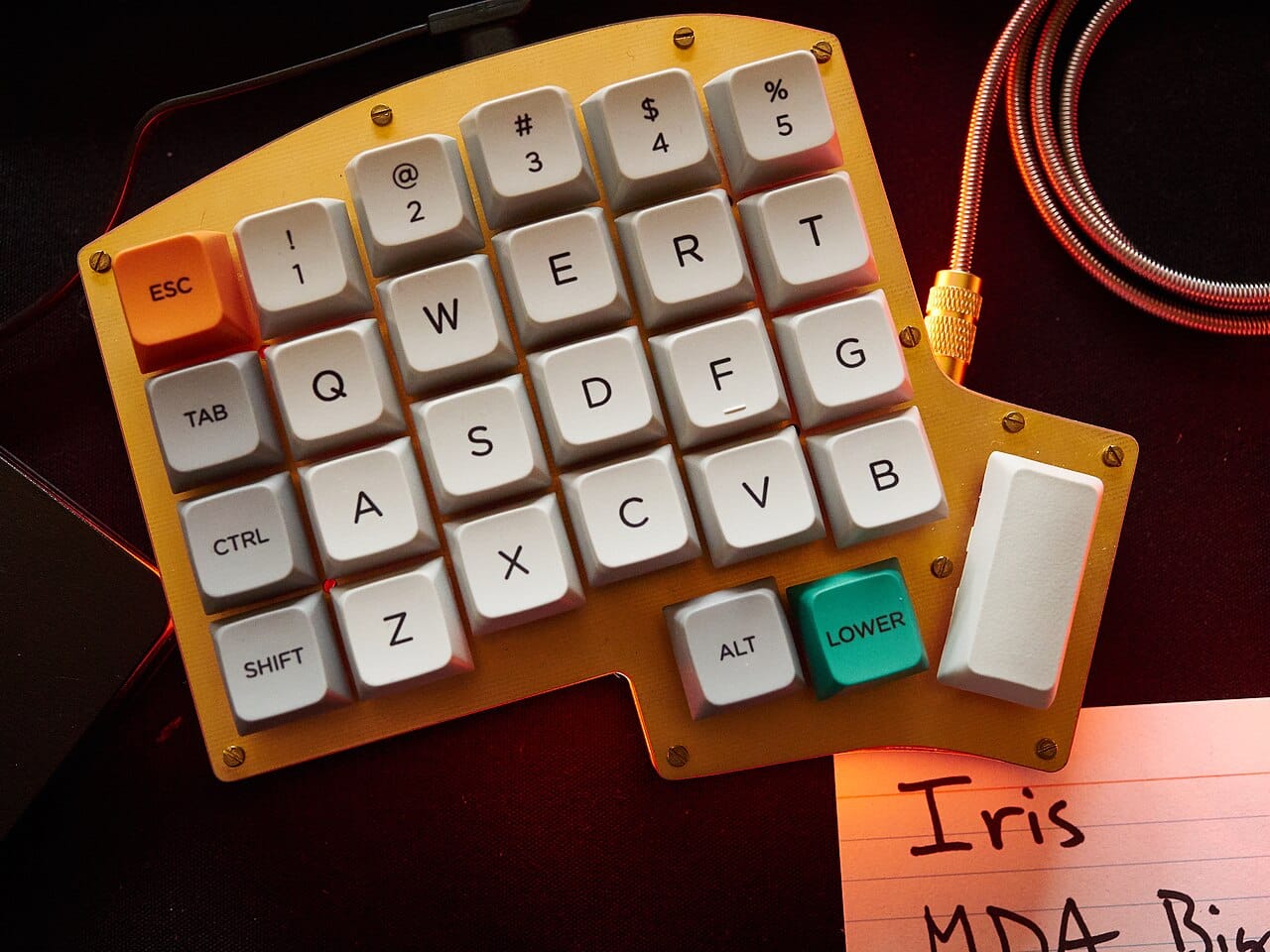
If you typed eight or more hours a day for a living in 2020, your default keyboard was a flat membrane board, an Apple Magic Keyboard, or for the keyboard-curious, something like a Keychron K8. In May 2026, the demographic of professional men typing for work — coders, lawyers writing briefs, accountants doing 8-hour spreadsheet days, journalists, consultants — is increasingly typing on split keyboards. And among the split keyboard population, two product approaches dominate: the polished commercial route led by the ZSA Moonlander, and the open-source DIY route led by the Lily58.
Why split keyboards finally became mainstream
Three trends converged. First, remote work normalised the personal workspace investment — when you're typing on the same desk for years, the £200-£400 difference between a flat keyboard and a split mechanical board amortises invisibly. Second, RSI complaints from millennials in their early 40s, who now have 20+ years of typing accumulated, are showing up in physiotherapy clinics — and split keyboards consistently produce 30-40% reduction in self-reported wrist pain in user studies. Third, the open-source firmware ecosystem (QMK, ZMK, VIA, Vial) matured into something a non-engineer can configure.
The Moonlander pitch
The ZSA Moonlander Mark I has been the polished commercial option since 2020 — adjustable tenting (up to 30 degrees), individually mounted Cherry MX switches, magnetic palm rest, beautiful aluminium chassis, the ZSA Oryx web-based configurator that requires no code, and a confidence-inspiring 2-year warranty. List price in May 2026: $375, plus shipping from Europe. The Moonlander reviews extremely well; the question is whether it's worth twice the price of a built Lily58.
What you get for the premium
- Out-of-box working keyboard with no soldering, no firmware flashing required for basic use.
- Best-in-class build quality — the aluminium chassis is noticeably more rigid than any DIY split, the keycaps are PBT injection-moulded.
- ZSA's Oryx configurator is genuinely the easiest split keyboard config tool — no other manufacturer has matched its visual layer editor.
- Tilt-and-tent mechanism: physical adjustment is more flexible than any DIY split, particularly for users who want vertical tenting beyond 15 degrees.
The Lily58 case
The Lily58 is a 58-key column-staggered split keyboard designed by kata0510, released as open source in 2019. Six years of community iteration produced what is, in 2026, the most-built DIY split keyboard ever. Components for a complete Lily58 Pro build in May 2026: PCBs ($30-50 a pair), case ($40-90 depending on material), switches ($45-65 for 58 switches at $0.80-1.10 each), keycaps ($45-120), MCUs ($20-30 a pair), TRRS cable ($8), miscellaneous ($15-25). Total build cost: $175-300, with most builders coming in around $220.
What you give up and what you gain
The Lily58 requires soldering (or hot-swap PCB version) and firmware flashing via QMK or ZMK. For someone who has never soldered, this is a 4-6 hour first build with a $30 soldering iron from Amazon. There is no warranty; if something fails, you fix it yourself or replace the component. Documentation is community wikis rather than glossy manuals.
What you gain: full hardware customisation. Choose your exact switches (silent linears, tactile, clicky), choose your case material (acrylic, wood, aluminium, 3D-printed), choose your keycap profile (Cherry, MT3, KAT, KAM), choose your tenting hardware. Layout is fully programmable — the standard Colemak/Dvorak/Workman options are available, but also custom layouts like home-row mods or layer-based punctuation. The Lily58 community has solved problems the Moonlander hasn't, like Miryoku layout for ergonomic minimum-finger-travel typing.
Who actually picks which
Three years of community polling on r/MechanicalKeyboards and the QMK Discord (4,500 respondents through 2024-2026) gives a clear pattern:
- Moonlander buyers: typically 35-55, high income, value ergonomic improvement over customisation, don't want to solder, have used premium keyboards before. About 55% are coders, 25% knowledge workers (consultants, lawyers), 20% writers/journalists.
- Lily58 builders: typically 28-50, more technically inclined, have built or modded other keyboards before, value the customisation explicitly, have time on weekends. About 70% are coders, 15% sysadmins/DevOps, 15% mixed.
The crossover
The interesting development in 2026: roughly 18% of Moonlander owners (from ZSA's own customer survey, released March 2026) have subsequently built a Lily58 or similar DIY split as a second keyboard. The reverse — Lily58 owners buying Moonlanders — is rare. Once you've experienced full hardware customisation, the Moonlander's fixed-everything approach starts feeling limiting.
Practical buying advice for May 2026
If you have never used a split keyboard, want one tomorrow, and don't want to solder: buy the Moonlander Mark I. The $375 buys six months of pain-free adoption versus the friction of building. If you have experience with mechanical keyboards, are comfortable with light tinkering, and care about the long-term customisation path: build a Lily58 Pro with hot-swap PCBs (no soldering required for switches), Boba U4T tactile switches, MT3 keycaps. Total cost around $260, time investment one weekend, and you can customise switches and keycaps indefinitely as your typing preferences evolve.
Neither is "better" in an absolute sense. The Moonlander is the better product if you treat it as a finished tool; the Lily58 is the better platform if you treat keyboards as something you continuously refine. For men who type for a living and have decided to invest in a split keyboard for the next decade, the Lily58 has quietly become the more rational long-term choice.