The 2026 Bluetooth Tracker Buyer's Guide for Men: Why the Network Matters More Than the UWB Chip
AirTag, Tile, and Samsung's SmartTag2 all promise to help you find lost keys, wallets, and luggage, but UWB precision finding is the least important spec on the box. Here's what actually decides whether you find your stuff.
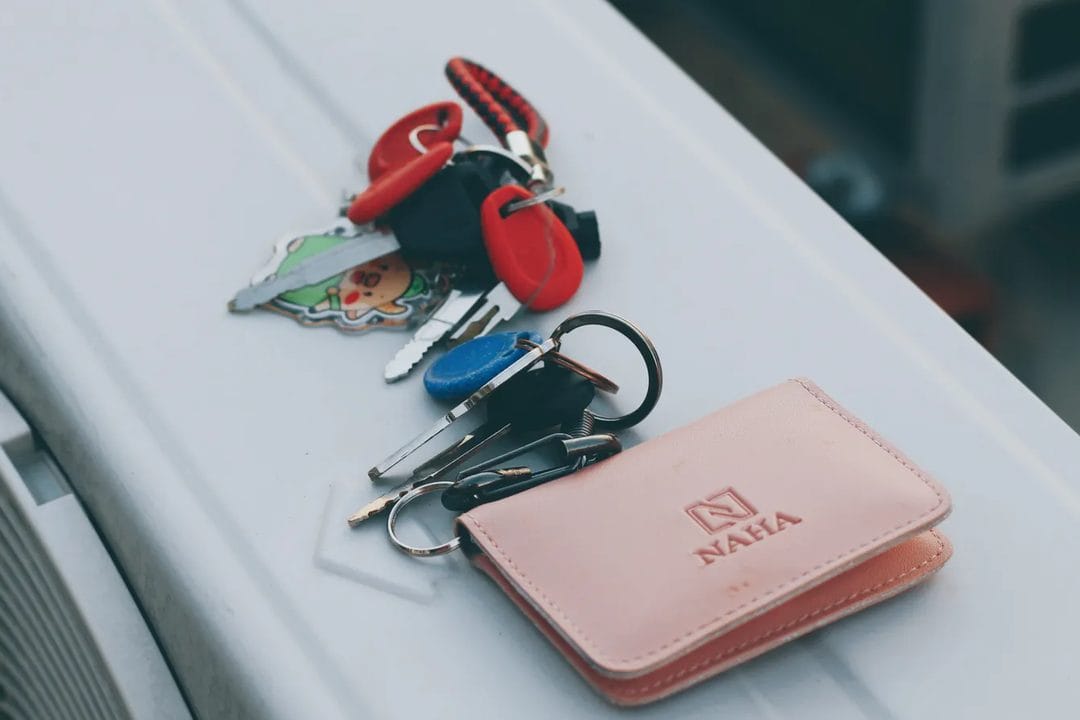
Your keys fell between the couch cushions three weeks ago and you found them in about four seconds, because a $29 disc of plastic on the keyring started beeping and an arrow on your phone pointed straight at the cushion. That's the whole pitch for Bluetooth item trackers, and it's a good one. What's changed in 2026 is which tracker actually does the pointing-an-arrow part well, and which one just tells you "somewhere in this room" and leaves you patting down the sofa anyway. The gap between those two experiences comes down to a chip most buyers have never heard of, and a network effect most buyers badly underestimate.
What UWB precision finding actually does (and when you don't need it)
Ultra-wideband, or UWB, is a short-range radio standard that measures distance by timing radio pulses instead of just reading signal strength, which is how plain Bluetooth trackers estimate location. The difference matters once you're within about 30 feet of the tracker: a Bluetooth-only device gives you a rough "getting warmer" signal, while a UWB-equipped one gives you a directional arrow and a distance in feet, accurate to a few inches. AirTag has had this since launch in 2021, via Apple's U1 chip, but it only works with an iPhone that also has a U1 or U2 chip — which means an 11 or newer. Samsung's SmartTag2 does the same trick with Galaxy phones from the S21 series up, using its own UWB chip.
Here's the part that trips people up: UWB precision finding is genuinely useful for exactly one scenario — the tracker is in the same room or car as you, and you can't see it. It does nothing for the far more common case, which is a tracker that's miles away because you left your backpack at a coffee shop. For that job, what matters isn't UWB at all. It's the size of the network of other people's phones quietly listening for your tracker's Bluetooth signal in the background, and that's a completely separate spec that most buying guides bury under the UWB marketing.
AirTag: the network that matters more than the hardware
An AirTag costs $29 on its own or $99 for a four-pack, and the hardware itself is nothing special — a coin-cell battery, a speaker, and that U1/U2 chip. What makes it the default recommendation for anyone in Apple's ecosystem is the Find My network: every iPhone running iOS 14.5 or later passively relays AirTag locations in the background, with no app running and no user awareness required. That's hundreds of millions of iPhones acting as a crowd-sourced location relay, which is why an AirTag left in a checked bag routinely reports its location from an airport tarmac or a delivery van, long before the bag physically reaches you.
The catch, and there's always one, is that AirTag is an Apple product built for Apple owners. Android users can install the "Find My Device" companion app to detect a nearby AirTag — mostly as an anti-stalking feature — but they can't add one to their own account, can't see its live location, and get none of the UWB precision finding. If your phone is a Pixel or a Galaxy, buying an AirTag is buying a tracker that works for exactly nobody in your household. Skip it.
Galaxy SmartTag2: the Android answer, mostly
Samsung's SmartTag2 runs $29.99 for the standard version, ships in a ring shape or a compact button shape, and rides on Samsung's SmartThings Find network — which is real but noticeably thinner than Apple's, since it only counts Galaxy phones, not the wider Android base. That's the trade-off nobody puts on the box: the tracker itself is arguably better built than an AirTag, with an official IP67 rating for dust and water versus AirTag's IP68 splash resistance in fine print, and a battery that Samsung rates at up to 500 days versus AirTag's roughly 12 months. But a tracker is only as good as the phones searching for it, and Samsung's install base is a fraction of Apple's globally.
Where this actually gets interesting for 2026 is Google's own Find My Device network, relaunched in 2024 and expanded through last year to include third-party UWB trackers from Chipolo and Pebblebee rather than a Google-branded tag. That network pools every participating Android phone, not just Samsung's, which on paper makes it the bigger crowd-sourced net — the practical reliability still lags Apple's head start by a couple of years of accumulated device density. If you're deep in the Samsung ecosystem specifically — Galaxy phone, Galaxy Watch, Galaxy Buds — SmartTag2 is the right call. If you're on a Pixel or another Android brand, a Chipolo or Pebblebee tag paired to Google's network will find more phones listening for it than SmartTag2 ever will.
Tile: the network problem no one talks about
Tile was the original mainstream item tracker, it predates AirTag by nearly a decade, and it's now the one to actively avoid for most buyers. The Tile Mate runs $24.99 and the Tile Pro $34.99, both perfectly competent little Bluetooth beacons with no UWB precision finding at all — you get a "getting warmer" proximity signal and nothing more, even standing right next to the thing. That alone would be a fair trade for a lower price. The real problem is the network: Tile's crowd-sourced finding relies on the Tile app being installed and running on other people's phones, and after Life360's 2021 acquisition folded Tile into its family-safety ecosystem, that installed base never came close to Apple's or even Samsung's passive relay numbers.
Tile also gates its best features — including a $1 million item-recovery guarantee that sounds generous until you read the fine print on what qualifies — behind a Tile Premium subscription running about $35 a year. That guarantee only pays out if Tile's own network physically relocates the item and you file a claim within a narrow window, and in five years of the product existing, actual payouts have been rare enough that owners mostly treat the number as marketing rather than insurance. Compare that to AirTag and SmartTag2, both one-time purchases with zero subscription requirement for full functionality, and Tile's value proposition gets hard to defend in 2026. There's one genuine exception: Tile trackers work across both iOS and Android without caring which ecosystem you're in, so a mixed household — one iPhone, one Galaxy — is the one situation where Tile's platform-agnostic app still earns its keep over a locked-in AirTag or SmartTag2. Even then, you're paying the subscription tax for a network that, by Tile's own admission, is smaller than either rival's.
Battery life and the replacement math nobody does
AirTag runs on a CR2032 coin cell, rated for about a year of use, and it's a $1 battery you'll find in any pharmacy — a five-minute swap with a coin to twist off the back cover. SmartTag2 uses the same CR2032 but stretches it to Samsung's claimed 500 days by dialing back Bluetooth broadcast frequency, which is also why some users report slightly laggier live-location updates compared to an AirTag. Tile is the outlier: the Mate and Slim use a sealed, non-replaceable battery good for one to three years depending on the model, and when it dies, the entire tracker goes in the bin rather than getting a fresh cell — a detail that matters if you're trying to avoid another piece of e-waste on top of the subscription.
Do the five-year math and the numbers separate fast. Five years of AirTag ownership costs $29 plus roughly five $1 coin cells, call it $34 total. Five years of Tile Pro with Premium runs $34.99 for the tracker, plus $35 a year for the subscription that unlocks the features worth having, which lands north of $200 before you've replaced a single dead unit. SmartTag2 sits in between at $29.99 plus a couple of battery swaps over five years, with no subscription tax at all. The battery isn't the interesting cost here — the subscription is, and it's the number most comparison charts leave out entirely.
Which one you actually need for keys, wallet, and luggage
For keys and a wallet — the two items you misplace inside your own home or car — the UWB precision finding is the feature that actually gets used weekly, so match the tracker to your phone: AirTag for iPhone, SmartTag2 or a Chipolo/Pebblebee tag for Android. Buy the four-pack of whichever you choose; putting one on the keys and one on the wallet and having two spares for a bag or a bike is cheaper per-unit than buying singles twice.
Luggage is a different problem entirely — you're not finding it in a room, you're confirming it made the connecting flight — and there the network size is everything, UWB is irrelevant, and AirTag's larger relay network wins outright for international travel regardless of what phone you carry day to day. Slide a slim AirTag card model into a suitcase's outer pocket, not buried inside, so it keeps a Bluetooth line of sight to nearby phones in the cargo hold and jet bridge. One caveat worth knowing before checkout: airlines including Lufthansa, American, and United have published guidance requiring any tracker with a lithium battery to stay in checked luggage that stays accessible or gets flagged, not because trackers are dangerous, but because a "missing bag" that's actually just delayed can trigger unnecessary alarm if the tracker keeps reporting a location the airline's own system doesn't show yet.
Skip Tile unless your household is genuinely split between iOS and Android and the cross-platform app is worth the subscription to you — for everyone else, it's the one item tracker in this comparison that costs more over five years and finds your stuff less reliably than either of its rivals.